Cartomancy with Playing Cards
Playing Card Divination
Origins and transmission: an ancient path, a living practice
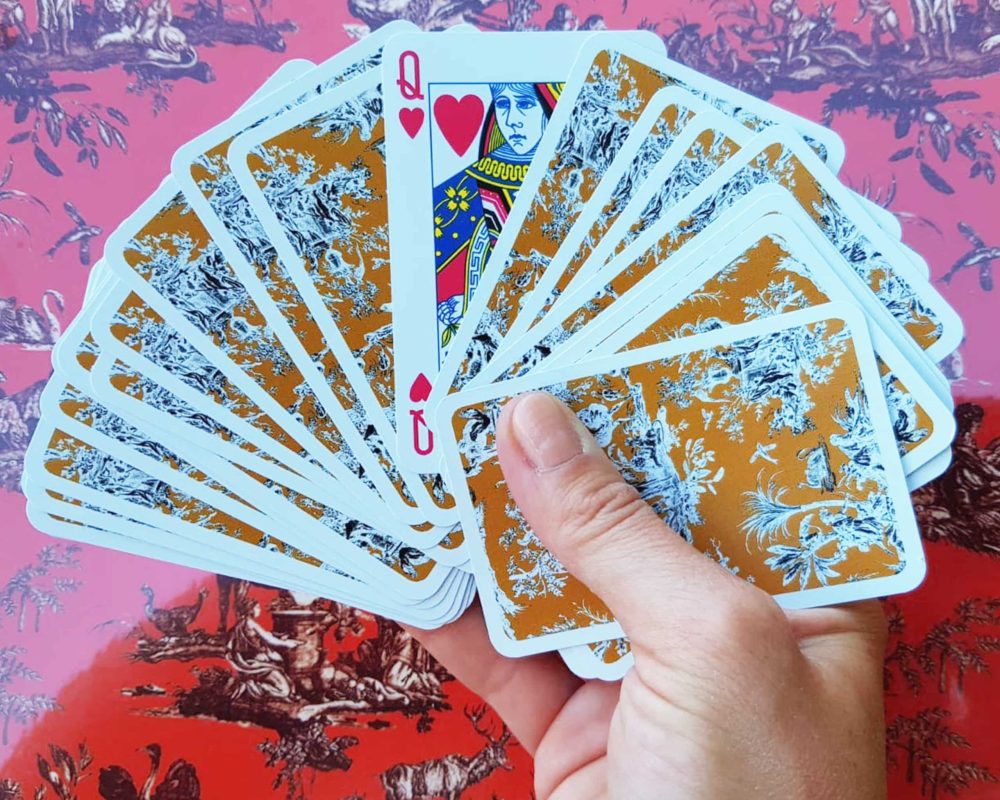
Playing card divination is one of the oldest and most widespread forms of divination, because it rests on a universal medium: a deck found in almost every culture. Its great strength lies in its simplicity: it does not require a complex esoteric system to be effective, because it is based on symbolic reading and the construction of a narrative (events, intentions, tensions, outcomes).
Historically, cards circulated in Europe as early as the 14th century, through trade routes connecting Western Asia, Egypt, North Africa, and then the West. Traces of older, similar media can also be found in Asia, and many hypotheses link the evolution of playing cards to regional games and systems (which varied according to materials, symbols, and social classes represented). But beyond debates about origins, what matters is this: playing cards were quickly adopted as a divinatory tool by popular, itinerant, and initiatory milieus — because they are easy to carry, discreet, and adaptable.
The tradition spread strongly through travellers and nomadic communities (including Romani groups), who used this rapid language to read the atmosphere of a place, assess a danger, understand a relationship, or anticipate a turning point. In this approach, the card is not a “magical object” in a naïve sense: it is a symbolic mirror that organizes what intuition already perceives.
The 4 suits: four universal reading axes
Most modern decks contain four suits: Hearts, Diamonds, Clubs, and Spades. From a divinatory perspective, they become domains, forces, or planes of life. Interpretive schools differ, but a recurring logic is:
This simple structure enables a “multi-layer” reading: you can read the domain (suit), then intensity and maturity (value), then interaction (combinations). This is exactly why playing cards become a powerful tool: they offer a clear image, while leaving enough space for intuition to connect the dots.
Court cards and values: psychology, roles, and events
Number cards often describe situations and phases, while court cards (Jack, Queen, King — sometimes Knight depending on tradition) embody people, roles, or psychological forces. In refined readings, a “court card” is not only someone: it can represent a facet of the querent, a posture to adopt, or an influence weighing on the story.
Reading values rests on a simple idea: the “higher” the value, the more the energy is structured, conscious, and decisive. Lower values speak of daily movement, an impulse, a detail that seems small but can change everything. Higher values speak of a choice, an authority, a destiny taking shape.
And the Joker?
In most traditions, the Joker is not used in divination, as it is a relatively late addition (introduced in the 19th century for entertainment purposes). However, some practitioners choose to include it as a symbol of the unexpected, a turning point, or freedom, similar to The Fool in Tarot: an element that breaks the script, forces one out of control, and opens a new path.
If you use the Joker, do so with one simple, stable rule (e.g., “unexpected,” “freedom,” “danger,” or “new beginning”), and keep the same meaning from one reading to the next. Consistency is the key.
How playing cards tell a story
Unlike a “fixed” reading, playing cards are exceptionally strong at creating a narrative. They show a sequence: a cause, a knot, a hidden element, then a direction. You do not read only “a card” — you read the links: who influences whom, what supports, what blocks, what accelerates.
That is why this divination is excellent for concrete questions: relationships, decisions, finances, work, travel, messages, conflicts, approximate timing. And it is also why it becomes a tool of self-knowledge: the cards often reveal the inner posture that creates the outer scenario.
Spread approaches (simple and effective)
Ideal for a quick, very clear reading.
Perfect for deciding “what to do now”.
Where this divination truly helps
- Clarify a relationship: intentions, loyalties, unspoken dynamics, likely evolution.
- Understand a blockage: what feeds it, what maintains it, what can dissolve it.
- Assess an opportunity: stability, risks, conditions to meet, approximate timing.
- Reveal an inner pattern: emotional posture, defense mechanisms, repetition, limiting beliefs.
- Make a decision: the most accurate action, what it opens, what it closes.
Playing cards do not “manufacture” the future: they reveal a tendency, a movement, and the internal logic of an unfolding scenario. The goal is not to create dependence on a prediction, but to restore lucidity, choice, and direction.
Αυτή η ανάρτηση είναι επίσης διαθέσιμη σε:
 Français
  Ελληνικά


You May Also Like

Lilith in the Signs — What It Truly Reveals About You
April 1, 2026
Holistic Medical Astrology & Soul Energy Protocol
June 20, 2026
