The Greek Magical Papyri
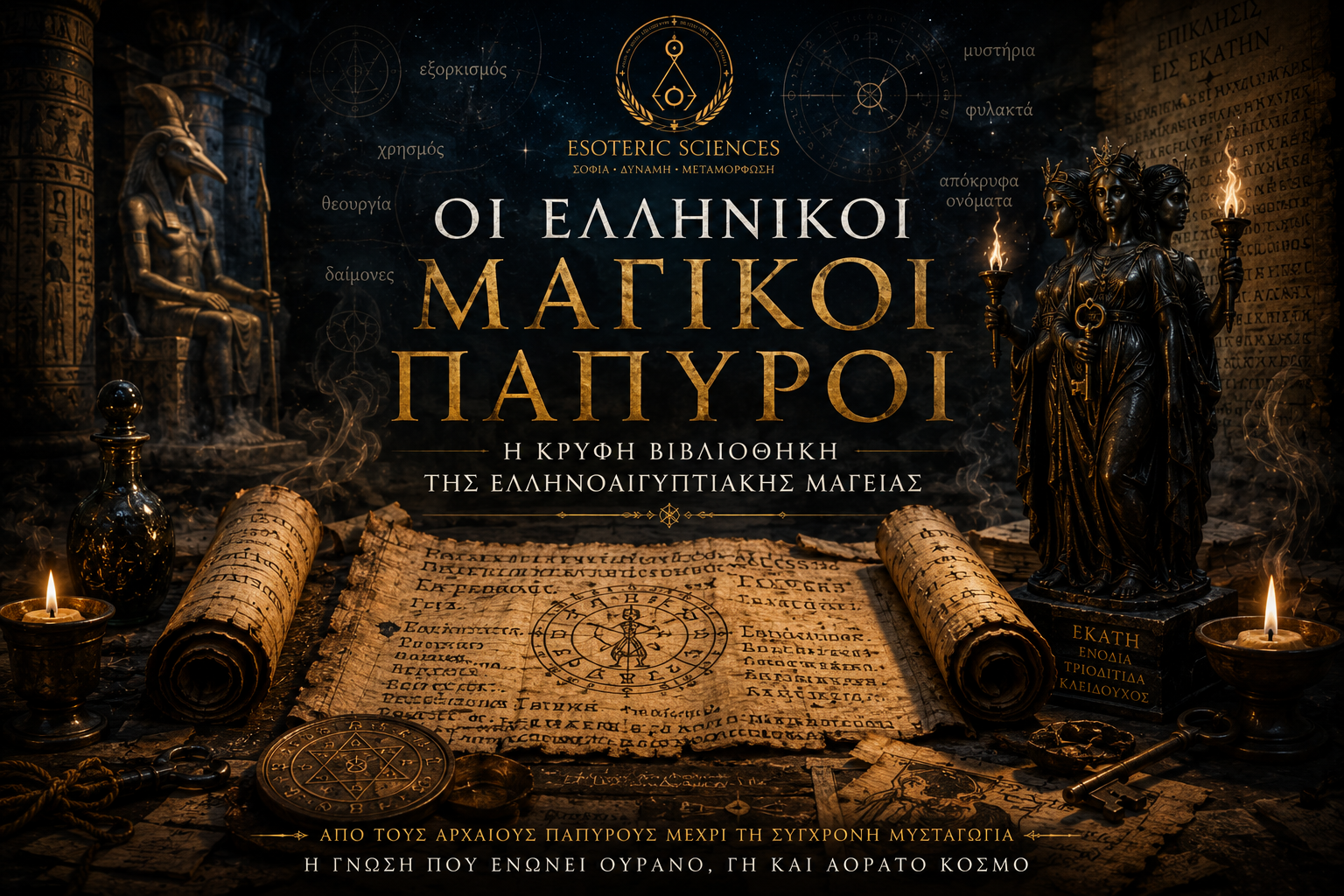
The hidden library of Greco-Egyptian magic: invocations, hymns, oracles, amulets, ritual recipes, and a unique window into the religious and magical world of Greco-Roman Egypt.
The Greek Magical Papyri, known internationally as Papyri Graecae Magicae or PGM, are not a single ancient book or the work of one particular author. They are a collection of manuscripts from different periods and origins, preserving an exceptionally complex landscape of ritual, religious, and magical practices from Greco-Roman Egypt.
The texts span many centuries and come mainly from Egypt in the Hellenistic, Roman, and Late Antique periods. Greek and Egyptian deities, Jewish divine names, astrological correspondences, hymns, healing practices, divination, and ritual magic can coexist within the same manuscript.
What the Greek Magical Papyri really are
The modern title describes a collection of papyrus manuscripts containing hymns, invocations, oracles, protective workings, dream practices, rituals for the manifestation of divine presence, amulets, and recipes addressing different needs of human life.
The texts do not all serve the same purpose. Some concern protection, healing, divination, or the pursuit of knowledge. Others deal with love, social influence, bindings, curses, or coercive practices.
The practices described in the Papyri belong to different historical, religious, and social settings. Their presentation here is historical, cultural, and research-oriented and is not an instruction for the mechanical reproduction of ancient rituals.
How the modern collection was formed
The designation Papyri Graecae Magicae (PGM) is a modern scholarly convention. The manuscripts were not discovered as a single archive bearing an ancient title. They entered modern scholarship gradually and are now dispersed among different libraries and collections.
Many of the best-known manuscripts are associated with the collection of Jean d’Anastasi. Earlier theories connected several of them with a supposed “Theban Magical Library,” although their exact provenance and original relationship to one another are not certain in every case.
Karl Preisendanz collected and published the core body of texts as Papyri Graecae Magicae. Later, the English translation under Hans Dieter Betz made the material more widely accessible. More recent research projects, such as Greek and Egyptian Magical Formularies (GEMF), re-examine the manuscripts with particular attention to their physical form, handwriting, languages, and history of transmission.
Modern papyrology no longer studies only the content of a “magical recipe.” It examines the manuscript itself as a material object: the handwriting, corrections, page layout, different languages, and traces of use.
Libraries, handbooks, and ritual objects
Not all surviving texts had the same function. Some were formularies, that is, collections of instructions and recipes that could be adapted to different people and circumstances. Others seem to have functioned more as personal or professional handbooks.
Alongside the handbooks, amulets, metal lamellae, ostraca, and other objects survive that had already been produced for specific use. The distinction matters: a written instruction is not the same thing as an object created within the context of a practice.
Corrections, different hands, and textual variants show that these texts were not always transmitted as fixed doctrine. Copying could involve adaptations, selections, and new combinations.
The Greco-Egyptian encounter
One of the most important features of the PGM is the coexistence of different religious traditions. Greek and Egyptian deities, biblical or Semitic names, and astrological elements may appear within the same ritual setting.
Helios may be associated with Egyptian solar deities, Hermes with Thoth, while deities such as Hecate appear within complex chthonic, lunar, and ritual contexts.
The Papyri allow us to observe a world in which different languages, deities, and ritual traditions could coexist within the same manuscript.
The language of the invisible: voces magicae and charaktêres
One of the most characteristic features of the Papyri is the voces magicae: sequences of sounds, names, and words that often cannot be translated in a conventional way.
Some preserve Egyptian, Greek, or Semitic elements. Others form distinctive sound sequences, repetitions, or palindromic structures. Their exact origin and function cannot always be determined.
Alongside them appear the charaktêres, linear and geometric signs found in manuscripts, amulets, and other ritual surfaces. They do not constitute a single alphabet, and their form or use varies considerably from text to text.
The anatomy of a ritual working
Despite the great differences among the manuscripts, certain recurring elements help us understand how a ritual act could be organized.
Preparation
Some texts prescribe purifications, abstinence, preparation of the space, or other preliminary actions before the main ritual.
The appropriate time
Hours, days, lunar phases, and astrological conditions could be regarded as suitable or unsuitable for specific practices.
The name and the voice
Divine epithets, names, hymns, commands, and distinctive vocal sequences form a central part of many ritual texts.
Matter and image
Inks, stones, metals, plants, perfumes, drawings, charaktêres, and amulets could all be incorporated into the ritual process.
Completion
Many texts include specific acts of completion, dismissal, storage, or destruction of the object that had been used.
The most important surviving manuscripts
The collection has no single “central” text. Certain manuscripts, however, are especially important for the modern study of magic and religion in Late Antiquity.
The Great Magical Papyrus of Paris
One of the most extensive surviving magical handbooks from antiquity. It contains hymns, divinatory and ritual workings, astral correspondences, vision rites, and both Greek and Egyptian elements. It also preserves the text that modern scholarship has called the “Mithras Liturgy.”
Bibliothèque nationale de France — Supplément grec 574.
The London Magical Handbook
An extensive papyrus containing practices of divination, protection, healing, and other forms of ritual magic. It also includes the Homeromanteion, in which Homeric verses are used for divination.
British Library — Papyrus 121.
The so-called “Stele of Jeu”
The manuscript contains various ritual workings. Especially well known is the text called the “Stele of Jeu” or the “Headless Invocation,” which much later acquired an important place in certain currents of the Western ceremonial tradition.
British Library — Papyrus 46.
The bilingual manuscripts
These manuscripts are especially important for the study of contact between Greek and Egyptian ritual traditions and contain different languages, scripts, and practices.
Related material is held in European papyrological collections.
They preserve more than texts. They retain pagination, different scribal hands, corrections, images, margins, and shifts between languages. Research can therefore examine not only what ritual specialists wrote, but also how they organized and transmitted knowledge.
What people sought through the Papyri
Divine presence
Invocations and hymns intended, within the religious framework of the texts, to approach or manifest a divine presence.
Dreams and oracles
Practices of dream divination, oracular consultation, and the search for answers through ritual forms of divination.
Protection
Amulets, apotropaic texts, and rituals that their users regarded as protective.
Knowledge and revelation
Rituals intended to obtain information, visions, or answers concerning unknown events.
Health and healing
Medico-magical recipes and practices reflecting period ideas about the body, illness, and healing.
Influence and coercion
Texts concerning social favor, love, rivalries, and coercive practices, revealing some of the darker dimensions of ancient magical practice.
The most important historical conclusions
The boundaries between magic and religion were complex
Hymns, prayers, exorcisms, sacrificial instructions, and practical needs may coexist in the same manuscript. Modern categories do not always correspond precisely to the way people of the period organized these practices.
Writing formed part of a broader ritual process
The utterance of words, hymns, divine names, charaktêres, and written inscriptions did not function in isolation but as parts of a complex ritual procedure.
Matter had ritual significance
Amulets, metals, stones, plants, inks, and other materials were selected according to the religious and magical ideas of the period and could take on a particular symbolic function.
Time was considered ritually significant
Certain hours, days, lunar phases, or astrological conditions were considered more suitable for specific ritual actions.
Everyday life stands at the center of the texts
Love, health, courts, work, trade, protection, fear, dreams, and human relationships appear alongside complex theological and cosmological invocations.
The Papyri as a mirror of Late Antiquity
The particular value of the Greek Magical Papyri lies in the fact that they tell us not only about deities and rituals. They allow us to glimpse the fears, desires, and everyday needs of people who lived many centuries ago.
Within the same manuscripts, the need for health, love, and protection meets the search for divine knowledge, divination, and contact with the supernatural. For historians of religion, papyrologists, and scholars of antiquity, this material provides a rare window into everyday religious experience.
A library preserved only in fragments
The Greek Magical Papyri represent only part of a much larger world of manuscripts and ritual traditions that did not survive. We do not know how many texts were lost or how much knowledge was transmitted exclusively by word of mouth.
What did survive, however, is enough to show that the magic of Greco-Roman Egypt was not a simple collection of “spells.” It was a complex cultural phenomenon in which religion, divination, astrology, medical ideas, writing, material culture, and different traditions of the eastern Mediterranean came together.
Frequently asked questions
Are the Greek Magical Papyri a single book?
No. The name is a modern designation for a collection of different manuscripts originating from different periods and ritual environments.
Do they contain only Greek magic?
No. Although a large part of the material is written in Greek, the texts come mainly from Egypt and display intense interaction among Greek, Egyptian, Jewish, and other traditions.
Why are they called “magical” papyri?
The term is a modern scholarly classification. The texts themselves contain practices that today may be classified as magic, religion, divination, astrology, or medico-magic, although the boundaries between these categories were not always clear in antiquity.
What are the voces magicae?
They are distinctive sequences of sounds, words, and names found in many magical texts. Some can be connected with known languages, while others remain difficult to interpret.
Why are they important for modern research?
Because they preserve direct evidence for the religious and ritual life of Greco-Roman Egypt and allow scholars to study the encounter between different cultures, languages, and religious traditions.
Key sources and digital text corpora
- Christopher A. Faraone & Sofía Torallas Tovar (eds.), Greek and Egyptian Magical Formularies: Text and Translation, Vol. 1 (2022). Open-access scholarly edition on eScholarship .
- Christopher A. Faraone & Sofía Torallas Tovar (eds.), The Greco-Egyptian Magical Formularies: Libraries, Books, and Individual Recipes (University of Michigan Press, 2022). Publisher’s page .
- Hans Dieter Betz (ed.), The Greek Magical Papyri in Translation, Including the Demotic Spells, 2nd edition. University of Chicago Press .
- Karl Preisendanz (ed.), Papyri Graecae Magicae: Die griechischen Zauberpapyri. Digital copy .
- PGM IV — Grand papyrus magique de Paris, Bibliothèque nationale de France, Supplément grec 574. Digital facsimile on Gallica .
- Papyri.info / Digital Corpus of Literary Papyri. PGM IV · PGM VII .
- Transmission of Magical Knowledge — research project on magical handbooks on papyrus and the history of their transmission. Project website .
Αυτή η ανάρτηση είναι επίσης διαθέσιμη σε:
 Français
  Español
  Ελληνικά
