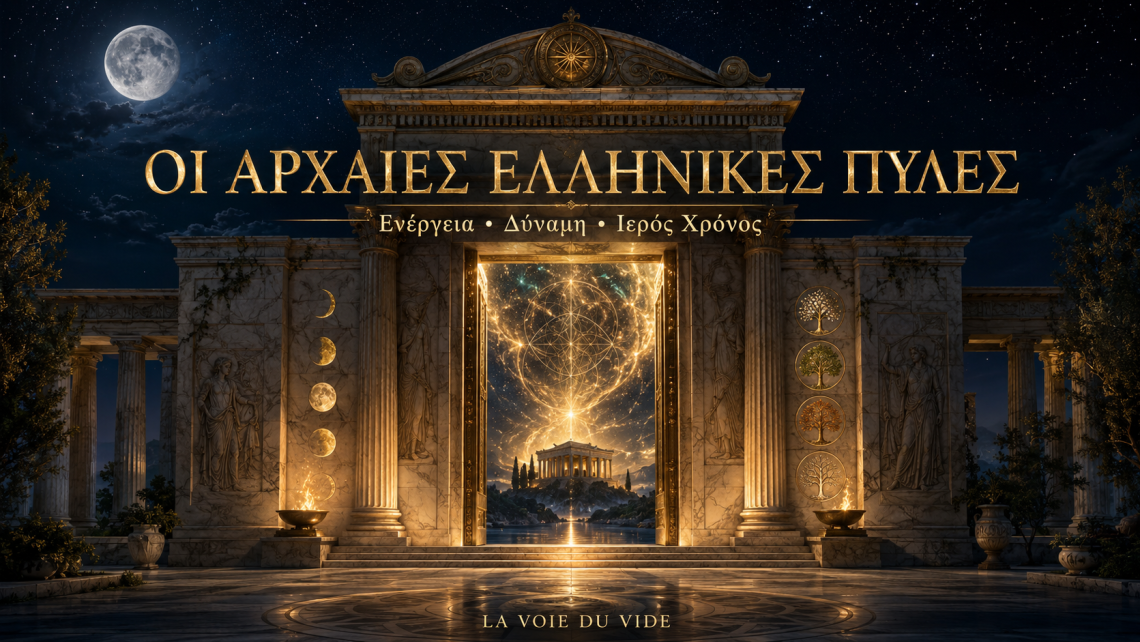
The Ancient Greek Gates: Energy · Power · Sacred Time
The Ancient Greek GatesEnergy · Power · Sacred Time
There are moments when time does not merely flow — it opens. Celestial cycles, sacred days and the rituals of the Greeks create thresholds of transition, purification, initiation and rebirth.
What is an energetic gate?
An energetic gate is a moment in time of heightened symbolic and ritual power. It is not a physical opening in space. It is a threshold where cosmic rhythm, collective memory, intention and action meet.
Within Greek sacred time, such thresholds were created by Noumenia and the final days of the lunar month, by festivals dedicated to deities, agricultural transitions, processions, purifications and mysteries. Each city had its own calendar; therefore, there was no single Panhellenic system with exactly identical dates.
The Gate does not do the work for you. It does, however, strengthen the moment in which intention, action and symbolism become aligned.
The Principal Gates of Power
These are not an arbitrary list of “magical dates.” They are living ritual thresholds that emerge from the ancient lunar and festival cycle.
Hekate’s Deipnon & Noumenia
The dark ending of the month was associated with Hekate’s Deipnon, purification and the removal of remnants. Noumenia opened the new lunar cycle with the renewal of the hearth and honouring of the gods.
When it opens today: The Deipnon is observed on the dark night at the end of the lunar month: around the astronomical New Moon or on the evening before the first slender crescent becomes visible. Noumenia begins with the first visible new crescent, usually 1–2 evenings after the astronomical New Moon. It is not a fixed annual date, but a monthly gate.
Energetic use: closure, purification, boundary protection, release and the planting of a new intention.
Anthesteria — The Gate of Souls
A three-day Dionysian festival of the new wine. The third day, Chytroi, was associated with offerings to the dead and with the idea that the boundaries between the living and the ancestors became thinner.
When it opens today: Approximately from mid-February to mid-March. Historically, it was celebrated on the 11th, 12th and 13th days of the lunar month Anthesterion, so the exact modern date shifts each year.
Energetic use: ancestral memory, acceptance of mortality, release of old grief and return to vital force.
Mounichia — The Lunar Flame
A festival of Artemis in Piraeus, held around the full moon. Round cakes bearing small flames were offered, an image joining the Moon, fire and divine protection.
When it opens today: Approximately in April or early May, close to the full moon of the period. The ancient festival took place on the 16th day of Mounichion.
Energetic use: clarity, independence, protection, strengthening of instinct and illumination of a hidden situation.
Thargelia — Purification and First Fruits
One of the important Athenian festivals of Thargelion. It included a strong purificatory element and the offering of first fruits, uniting the removal of miasma with gratitude for what was coming to maturity.
When it opens today: Approximately from mid-May to mid-June. In Athens, the Thargelia were celebrated on the 6th and 7th days of Thargelion.
Energetic use: purification, removal of stagnation, healing one’s relationship with abundance and blessing a new undertaking.
Panathenaia — Wisdom, City and Protection
The great festival of Athens in honour of Athena culminated in a procession and the offering of the peplos. It was a gate of collective identity, order, skill, intellect and protection of the community.
When it opens today: Approximately in late July or early August. The great procession culminated on the 28th day of Hekatombaion. The Greater Panathenaia were held every four years, while the lesser Panathenaia were celebrated annually.
Energetic use: strategy, mental clarity, success in an undertaking, protection of the home or professional space.
Eleusinian Mysteries — Descent and Return
Perhaps the most powerful initiatory threshold of the Greek world. The precise sacred rites remained secret, but their core was associated with loss, descent, searching, return and hope beyond death.
When it opens today: Approximately in September or early October, often close to the autumn equinox. The Greater Mysteries unfolded primarily between the 15th and 21st days of Boedromion.
Energetic use: profound transition, shadow work, grief, rebirth and acceptance of life’s great cycles.
Thesmophoria — The Womb of the Earth
A women’s festival linking human fertility with the renewal of vegetation and the survival of the community. The cycle included descent, fasting and a ritual return to fertility.
When it opens today: Approximately from mid-October to mid-November. In the Athenian calendar, the principal three-day observance took place on the 11th–13th days of Pyanepsion. Dates differed in other Greek cities.
Energetic use: feminine power, creativity, grounding and preparing a project before bringing it into manifestation.
Pyanepsia — Gratitude and Return
The festival was associated with boiled produce, the eiresione and gratitude for a safe return. It expresses the moment when ordeal becomes knowledge and the first fruits are returned to the divine.
When it opens today: Approximately in October or early November. The Pyanepsia were celebrated on the 7th day of Pyanepsion, a few days before the Thesmophoria.
Energetic use: gratitude, completion of a journey, protection of the home and recognition of what has already borne fruit.
Lenaia — The Flame within Winter
A winter Dionysian festival featuring dramatic competitions. In the darkest season, Dionysus expresses a power that is not lost but transformed, ripened and returned as ecstasy and creation.
When it opens today: Approximately from mid-January to mid-February. The precise duration of the ancient Lenaia is not completely certain, but they are usually placed around the 12th–15th days of Gamelion.
Energetic use: creative awakening, emotional release, transformation of fear and reconnection with joy.
The Solstices and Equinoxes
Ancient Greek festivals did not form a unified “Wheel of eight festivals.” Nevertheless, changes in light and the seasons shaped agriculture, navigation and ritual time.
When they open today: Spring equinox around March 20, summer solstice around June 20–21, autumn equinox around September 22–23 and winter solstice around December 21–22. The exact time changes every year.
Energetic use: balance at the equinoxes, culmination and manifestation at the summer solstice, inward turning and rebirth at the winter solstice.
The Four Movements of Light
Not all gates have the same function. Their power is understood through their position within the cycle.
How to Work with a Gate
Serious work does not require theatricality. It requires a clear purpose, appropriate symbolism, presence and responsibility.
A candle, clean water, a few words of honour and a specific intention are enough for a simple personal practice.
We do not invent “ancient secrets” or present as certainty what the sources have not preserved. We work with the known symbolic core.
Which Gate Do You Need?
| Purpose | Suitable Gate | Central Action |
|---|---|---|
| Purification & new beginning | Hekate’s Deipnon → Noumenia | Release and new intention |
| Ancestors & memory | Anthesteria | Quiet offering and honour |
| Protection & clarity | Mounichia / Panathenaia | Light, prayer, boundaries |
| Deep transformation | Eleusinian period | Silence, descent, renewal |
| Creation & fertility | Thesmophoria | Grounding and gestation of a project |
| Gratitude & fruition | Thargelia / Pyanepsia | Offering of first fruits |
| Joy & creative fire | Lenaia | Expression, art, transformation |
Αυτή η ανάρτηση είναι επίσης διαθέσιμη σε:
 Français
  Español
  Ελληνικά


You May Also Like

Detailed Monthly Forecasts for April 2026 — Monthly Horoscope for Love, Finances, with Each Week Analyzed Separately
April 2, 2026
Tarot Cards
March 6, 2026