Hecate
One of the most complex deities of the ancient Greek religious tradition: a goddess of boundaries and transitions, roads and crossroads, night, torches and, in later traditions, magic and the unseen.
The figure of Hecate changed considerably across the centuries. From the earliest Archaic testimonies to the Classical, Hellenistic and Roman periods, different aspects, epithets and cultic functions became associated with her name, shaping a deity far more complex than the modern image of Hecate solely as a “goddess of magic.”
Torches • Crossroads • Boundaries • Night • TransitionWho Is Hecate?
Hecate is an ancient deity already present in early Greek sources, but her identity and functions did not remain static.
In Hesiod’s Theogony, she is presented with exceptional honour and with authority extending across more than one realm of the cosmos. This early image is broader than the dark, nocturnal figure for which the goddess became better known in later periods.
As ancient Greek religion developed, Hecate became strongly associated with entrances, roads, crossroads and liminal spaces. Torches became one of her most recognisable attributes, while her connections with night, spirits, the underworld and magic grew especially prominent in later Greek and Greco-Roman traditions.
“Hecate’s torch does not abolish the night. It offers the light needed to cross a threshold.”Hecate as a Deity of Boundaries
The Many Faces of Hecate
Like many ancient deities, Hecate appears in the sources and in cult traditions under different epithets. These epithets illuminate particular qualities or functions and should not be treated as entirely separate deities.
Enodia
Hecate’s relationship with roads and points of passage is reflected in traditions and epithets that connect her with movement, boundaries and intersections.
Trioditis
The association with three-way crossroads became one of Hecate’s most characteristic aspects. The point where different roads meet acquired strong ritual and symbolic significance.
Phosphoros
The image of the goddess carrying burning torches is deeply connected with ancient iconography and her mythological presence. Light functions as a symbol of guidance through darkness.
Soteira
Hecate was not only a fearsome or chthonic figure. In different religious contexts she could also be understood as a protective, beneficent and saving deity.
Hecate at the Crossroads
Hecate’s association with crossroads is one of the most enduring features of her later cultic and symbolic image.
A crossroads exists between directions. It belongs exclusively to none of the roads that meet there.
In the ancient world, crossroads could be regarded as distinctive spaces, because they were points of meeting, separation and transition. Hecate became associated with such places and with the protection or supervision of boundaries and passages.
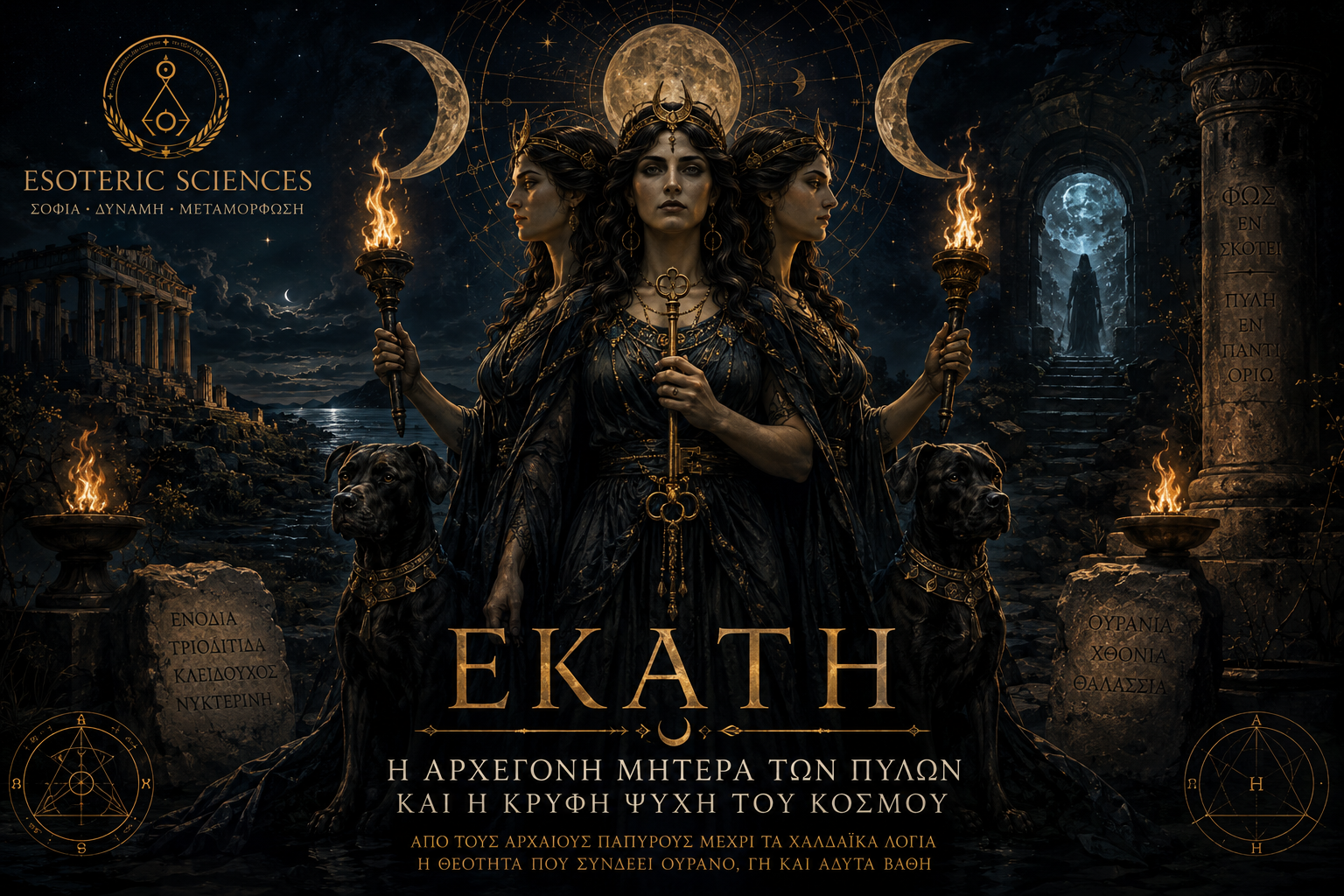
The triple representation of the goddess, especially known through the Hekataia, became linked with this function: a figure able to look in different directions while standing symbolically at the centre of a liminal place.
In modern esoteric thought, the crossroads is also often used as a metaphor for choice, change and periods in which an old path ends and a new one must be chosen. This psychological or symbolic reading is a modern interpretation and should not automatically be identified with ancient cult practice.
The Most Important Symbols of Hecate
The goddess is recognisable through a number of recurring attributes. Their meaning, however, changes according to period, source and religious context.
The Torch
Torches are an authentic and important attribute of Hecate. They connect her with light within the night, the search, the journey and guidance through liminal spaces.
The Key
Keys became especially associated in later traditions with Hecate’s role as guardian of boundaries and entrances. In modern esotericism they became a symbol of access, protection and transition.
The Dog
The dog has a strong relationship with Hecate’s cultic and mythological tradition. Ancient references to dogs, nocturnal barking and ritual practices contributed to the animal’s long-standing association with the goddess.
The Three-Way Crossroads
Three-way crossroads are among the most important spaces associated with Hecate. Different directions meet there, and the landscape itself takes on the character of a boundary.
“Hecate’s fire is not the midday sun. It is the torch that accompanies the journey through the night.”Torches and Nocturnal Symbolism
The Torches of Hecate
The torch is one of the most characteristic elements of Hecate’s iconography and is directly connected with her role as a companion and luminous presence.
In the Homeric Hymn to Demeter, Hecate appears bearing light in her hands and takes part in the search for Persephone. This episode contributed to her strong association with torches, night and transition between different states.
On a symbolic level, the torch is a particularly powerful image: it does not erase all darkness, but creates a limited circle of visibility. For this reason, in modern esoteric interpretation, it may symbolise the knowledge that makes the next step possible, without revealing the entire path.
The Darker Aspect of Hecate
The modern image of Hecate is strongly influenced by later traditions that associated her with night, the dead, ghosts and magic.
As Greek and Greco-Roman religious traditions developed, Hecate acquired stronger chthonic and nocturnal associations. She appears in texts and magical traditions in connection with spirits, the dead, nocturnal rites and powers believed to exist beyond ordinary human experience.
This does not mean that Hecate was from the beginning exclusively a “dark goddess.” Her image is historically complex. Protection, light, beneficent power and celestial associations coexist in her traditions with chthonic and magical dimensions.
Later Western esoteric traditions, modern witchcraft and various Neopagan currents placed renewed emphasis on particular aspects of the goddess. These contemporary practices belong to the modern history of Hecate’s reception and should not all be presented as unchanged rituals inherited directly from antiquity.
Hecate and Magic
Hecate’s connection with magic is genuine, but it has a history and an evolution. It does not appear in exactly the same form in every period.
A Broad Divine Figure
Early sources present a deity with broader powers and honours. Her later identification exclusively with magic does not represent the whole Archaic image.
Boundaries and Night
Her associations with entrances, crossroads, nocturnal presence and the chthonic dimensions of religious experience become stronger.
Magical Tradition
Hecate acquires a distinctive place in magical and theurgical contexts, where names, invocations and complex theological conceptions surrounding her figure multiply.
Modern Esotericism
Today Hecate holds an important place in different esoteric and Neopagan currents. Contemporary forms of worship and practice, however, are not all historically identical to ancient ones.
Hecate as an Image of Female Autonomy
In modern spirituality, Hecate has also acquired new symbolic readings connected with autonomy, boundaries, intuition and the power of choice.
The woman holding the torch and standing at the crossroads has become, for many modern readers, a powerful archetype of independence and inner sovereignty.
This reading holds a particular place in modern esoteric literature, where Hecate is often associated with the ability to establish boundaries, leave an old cycle behind and consciously choose a new direction.
It is important, however, to distinguish this modern psychological and archetypal interpretation from the historical study of the ancient deity. The two approaches can coexist, but they are not the same thing.
Articles About Hecate
The history of Hecate extends from ancient Greek religion to later magical, philosophical and esoteric traditions. This section gathers the related studies and articles.
Hecate — The Primordial Mother of the Gates and the Hidden Soul of the World
A more extensive study of Hecate, her different aspects, symbols, religious traditions and the later esoteric connections that developed around her figure.
From the Ancient Goddess of Boundaries to Modern Hecate
Hecate cannot be reduced to a single attribute. Ancient sources, cult, iconography and later esoteric traditions shaped a complex figure that connects light with night, protection with the unseen, the road with the crossroads, and the fixed boundary with transition.
The historical Hecate and the Hecate of modern esotericism are not completely identical. Distinguishing between ancient evidence, later traditions and modern symbolic interpretations allows for a deeper and more meaningful understanding of the goddess.
Note: References to magic, esoteric tradition, archetypes and symbolic interpretations are presented here as historical, religious-studies and cultural material.
Αυτή η ανάρτηση είναι επίσης διαθέσιμη σε:
 Français
  Español
  Ελληνικά
