The Festivals of Hekatombaion
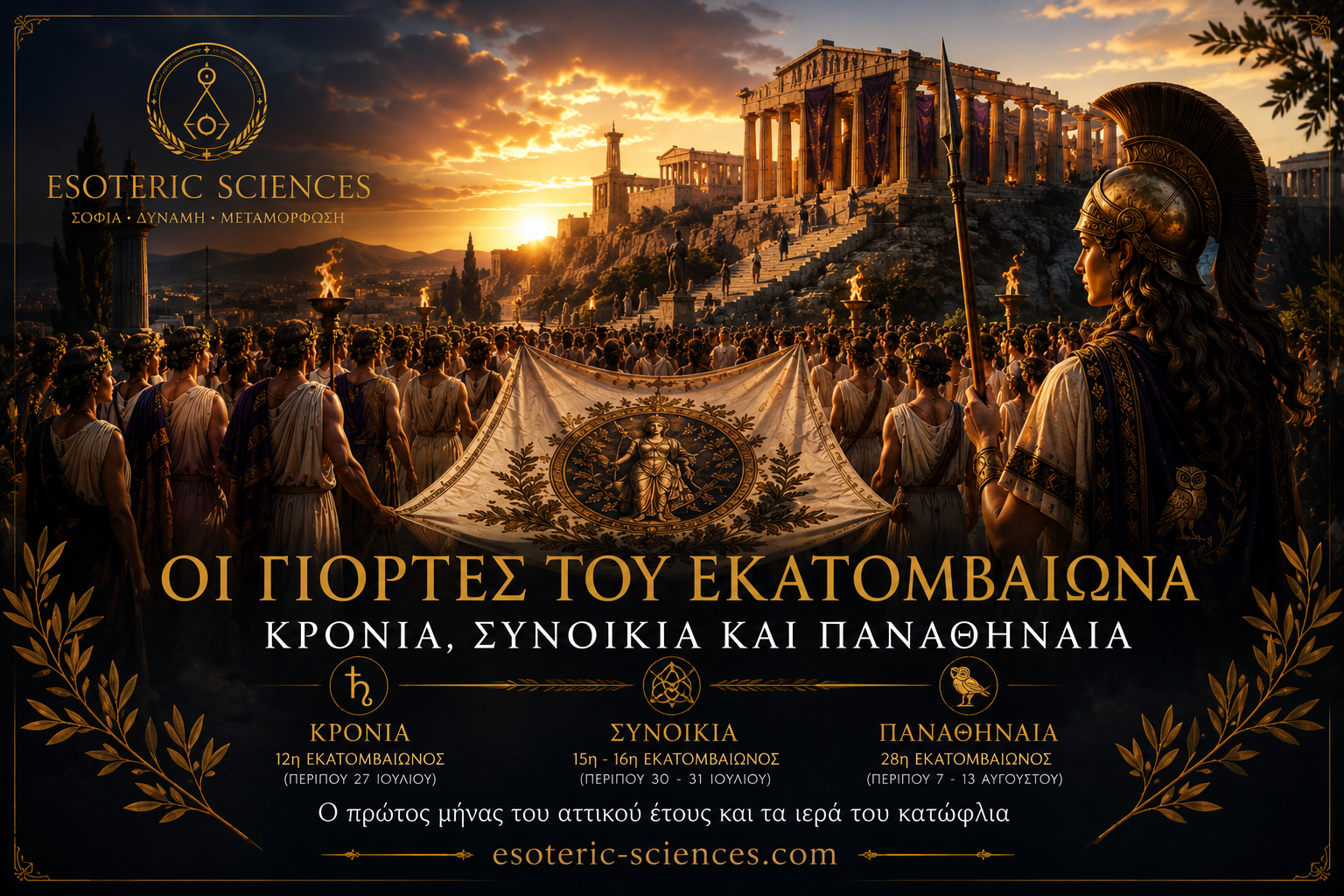
Kronia, Synoikia and Panathenaia: three ancient festivals, three successive Gates of Power. First the old law is loosened, then the fragmented parts are reunited, and finally the new path gains wisdom, form and direction.
The Hekatombaion, the first month of the Attic calendar, did more than open a new calendrical year. It opened an entire ritual journey. Its festivals led the city from the memory of an older age, to the union of divided communities, and finally to the great public dedication to Athena, protectress of Athens.
They are not merely dates. They are three thresholds of transformation.
Each of these festivals touches a different and absolutely necessary stage of life. The Kronia reveal what must cease to rule you. The Synoikia bring back into unity what has become fragmented within you. The Panathenaia ask you to transform new awareness into strategy, action and conscious direction.
For this reason, the period of Hekatombaion can function as one of the most complete Gates of Ancient Power: it does not promise an instant change, but guides you step by step from release, to reunion, and finally to the establishment of a new cycle.
When one festival speaks to you more strongly than the others, it often reveals the stage your own life is currently passing through.
There was no single calendar shared by all ancient Greek cities. The festivals examined here belong primarily to the Attic or Athenian calendar. Their correspondence with modern dates is reconstructed and may vary by one day, depending on how the Noumenia and the first visible Moon are calculated.
A month that did not begin by chance
The beginning of Hekatombaion fell after the summer solstice and was linked to the appearance of the new lunar cycle. The Sun had already reached the highest point of its annual course and the light was gradually beginning to change direction. At the same time, the Moon was beginning to wax again.
Within this celestial threshold came the first major festivals of the year. They were not three unrelated rites. Viewed as a whole, they form a coherent progression:
Reversal
The Kronia temporarily loosen the established social order.
Union
The Synoikia remind us that separated parts must be united into one body.
Establishment
The Panathenaia dedicate the organized city to Athena.
Kronia
The Kronia were celebrated in honor of Kronos and were linked to the memory of the mythical Golden Age: an age of abundance, before the reign of Zeus, when people were believed to live without the harshness, toil and pronounced social distinctions of later life.
The festival probably had older agricultural roots and was associated with the completion of the grain harvest. Kronos was often depicted with a sickle, a tool that could signify both harvest and the cutting of a cycle that had reached maturity.
The temporary reversal of the social order
The most distinctive feature of the Kronia was the temporary easing of the distance between masters and slaves. Sources mention shared meals, rest from work and a symbolic reversal of customary roles.
This did not mean that Athenian society actually abolished slavery or its social inequalities. For one day, however, the normal structure ceased to appear absolute and unchangeable. The city remembered a mythical time before the establishment of the present order of power.
Historical meaning
Rest, a shared meal, remembrance of the Golden Age and a temporary easing of social divisions.
Inner meaning
Examining the authorities, rules and habits we continue to serve even when they no longer benefit us.
The Kronia can be seen as the Gate where the old order temporarily ceases to be taken for granted. Before a new cycle can be built, we must recognize which old laws still govern us and which need to lose their power.
How it can be used today
In the initiatory work of the Gate, the day can be devoted to release from rigid roles, old obligations, exhausting habits and relationships of power. It is not a day of boundless chaos. It is a day to examine honestly which order serves life and which imprisons it.
The Gate that weakens the old law
The energy of the Kronia becomes especially significant when you know that something has ended, yet an old duty, fear, role or power relationship still determines your choices.
Personal work with this Gate helps you discern which structure needs to be released and which wisdom must be retained, so that release does not become chaos but a conscious transition.
Synoikia
The Synoikia commemorated the unification of the different demes and communities of Attica into a single political and religious body centered on Athens.
Mythic tradition attributed this union to Theseus. According to Plutarch, Theseus abolished the separate prytaneia and councils of the individual communities, created a common administrative center and established the related festival on the 16th day of Hekatombaion.
In some reconstructions, the larger form of the festival began on the 15th day and concluded on the 16th. The 16th of Hekatombaion remains the principal and most securely documented date.
What synoecism meant
The word synoecism comes from the idea of dwelling together. It did not simply mean that many people lived near one another. It meant that separate communities accepted a common political identity, shared principles, common rites and a shared responsibility for the future.
The festival reminded people that a city is not made only of walls, roads and buildings. It is created when different groups accept that they belong to something greater than their separate interests.
Historical meaning
Remembrance of the political unification of Attica, honor to Athena and reaffirmation of a shared Athenian identity.
Inner meaning
Reuniting the fragmented aspects of the self and concentrating power toward a common direction.
There can be no true new beginning when the will moves in one direction, fear in another, and old commitments in a third. The Synoikia express the need for separated parts to return to a common inner center.
How it can be used today
This period can be used for reconciliation, reconnection and the restoration of cooperation where that is healthy and possible. It can also be used to bring together personal goals that until now have been in conflict.
Union does not mean returning to a harmful relationship or abandoning personal boundaries. It means creating coherence among our values, decisions and actions.
The Gate that brings fragmented power back to the center
The Synoikia form an essential Gate for times when the heart wants one thing, the mind fears another, and actions move in a third direction. As long as the inner parts remain divided, energy leaks away and decision weakens.
In a private session, the work focuses on what needs to be reunited within you, which boundaries must remain, and what shared direction can truly support you.
Panathenaia
The Panathenaia were the most important civic festival of Athens. They were celebrated in honor of Athena Polias, the goddess who protected the city, public order, strategic thought, craftsmanship, defense and its collective identity.
The festival was held every year. Every four years it took on a much larger and more splendid form known as the Great Panathenaia, with expanded musical, athletic and equestrian competitions.
The period from the 23rd to the 29th of Hekatombaion is often used in modern calendrical reconstructions of the multi-day program. The most securely documented date is the 28th of Hekatombaion, the day of the great procession and sacrifice to Athena.
The great Panathenaic procession
The great procession moved from the Kerameikos district, passed through the city and proceeded toward the Acropolis. Priests, priestesses, young men, maidens carrying sacred objects, officials, citizens, musicians, athletes and delegations took part.
The procession was not merely a public display. It presented the city to itself as an organized whole. Each group had a place, a role and a responsibility within the collective movement toward the sacred center.
The peplos of Athena
A central element of the tradition was the offering of the woven peplos to Athena. The peplos was associated with the goddess’s victory in the Gigantomachy and signified the triumph of ordered cosmic structure over the forces of uncontrolled dissolution.
The fabric was not merely a garment. It was the product of time, skill, cooperation and dedication. Each thread was woven into a larger design, just as each citizen was integrated into the body of the city.
Games, music and sacred olive oil
The broader program included athletic, equestrian, musical and poetic contests. At the Great Panathenaia, rhapsodic recitations, footraces, chariot races and musical competitions held a special place.
A distinctive prize was the Panathenaic amphorae, which contained valuable olive oil from Athena’s sacred olive trees. Victory was rewarded not only with honor but with a product directly connected to the goddess and the identity of the city.
Historical meaning
Honor to Athena, public procession, sacrifices, contests, music, a communal meal and renewal of Athenian identity.
Inner meaning
Transforming intention into organized action, strategic direction and conscious dedication of the new cycle.
After the reversal of the Kronia and the union of the Synoikia, the Panathenaia establish the new order. It is not enough to free ourselves from the old or to reunite our parts. We must give the new power form, strategy and a specific direction.
The Gate that transforms intention into organized power
The Panathenaia are the culminating Gate of the cycle because they demand more than inspiration: they demand wisdom, strategy, discipline and a work that can stand in the real world.
Personal work with this energy helps you see which new path deserves to be established, which plan needs structure, and what first step will turn inner change into tangible reality.
The three festivals as one initiatory journey
Viewed together, the festivals form a path that remains active and applicable to inner work.
| Festival | Ancient function | Inner work of the Gate |
|---|---|---|
| Kronia | Temporary loosening of order and remembrance of the Golden Age. | Recognition and release of old roles, restrictions and power relationships. |
| Synoikia | Celebration of the unification of the communities of Attica. | Union of the fragmented aspects of the self and concentration on a common purpose. |
| Panathenaia | Public dedication of the city to Athena. | Establishment of a new structure, strategy and conscious direction. |
Working with the three successive Gates
-
At the Kronia: release the old law.
Write down a role, a fear or an obligation that still governs your life even though it no longer expresses who you are. -
At the Synoikia: unite what has been fragmented.
Recognize which needs, desires or aspects of yourself are in conflict. Create a shared direction that does not invalidate any essential part of you. -
At the Panathenaia: give form to the new.
Choose a specific goal, a practical plan and the first step to be carried out immediately. The new order must become action.
“I release the law whose time has come to an end.
I unite what within me was divided.
I give my new path form, wisdom and direction.
May what is founded now serve truth, justice and the common good.”
The place of Hecate in the transition
Hecate was not the central deity of the Kronia, the Synoikia or the Panathenaia. The Kronia were associated with Kronos, while the Synoikia and especially the Panathenaia had Athena as their principal divine figure.
The connection of Hecate with this festive sequence is a broader initiatory reading. Hecate was associated with gates, entrances, roads, crossroads and the points where one state passes into another.
Hecate’s Deipnon belonged to the end of the lunar month and functioned as a purification before the Noumenia. Therefore, her historically more accurate place lies at the threshold before the beginning, not as the central deity of each festival that follows.
In the work of the Gates of Ancient Power, Hecate is recognized as the force that illuminates the passage: she who holds the key, reveals the different directions and requires us to choose consciously which road we will follow.
Why these festivals remain important
Ancient festivals were not simply breaks from everyday life. They ordered time, renewed communal memory and gave people a shared language for confronting change.
The Kronia reminded people that no human power is eternal. The Synoikia, that without union there is no stable body. The Panathenaia, that power without wisdom, structure and strategy cannot create civilization.
Their real value today does not lie in blindly reproducing ancient rites. It lies in understanding the mechanism they embodied: first the old is dismantled, then the pieces are reunited, and finally a new order is established.
For the ancient Greeks, a festival was not simply a remembrance or a pause in daily life. It was an activation of sacred time: a moment when human beings, the city, the deities and cosmic cycles met within a specific ritual order. In this sense, every major festival functioned as a Gate of energy, transition and power.
Frequently asked questions
When are the Kronia celebrated in 2026?
Using the calendrical reconstruction that places the first day of Hekatombaion on July 16, the 12th of Hekatombaion corresponds approximately to July 27, 2026. The correspondence may vary by one day.
Did the Synoikia last one or two days?
The 16th of Hekatombaion is the principal historically documented day. In some reconstructions, the larger form of the festival also includes the 15th day.
What was the difference between the Lesser and the Great Panathenaia?
The Panathenaia were held every year. Every four years, the expanded form of the Great Panathenaia was organized, with more contests, ceremonies and participants.
Was Hecate part of these three festivals?
She was not the central deity of these particular festivals. Her place in this initiatory sequence is based on her character as a goddess of boundaries, gates, roads and transitions.
Why do the festivals function as energetic Gates?
In ancient Greek thought, sacred time, celestial cycles, rites, processions and dedications were not separate from one another. They created specific thresholds of transition through which the community and the individual passed from one state to another. The Kronia, Synoikia and Panathenaia function as successive Gates of release, reunion and the establishment of new power.
Which of the three Gates is asking to open for you now?
Perhaps you are at the Kronia and need to release an old law. Perhaps you are at the Synoikia and need to gather your fragmented power again. Or perhaps the moment of the Panathenaia has arrived: to give the new direction form, strategy and a real place in your life.
Through a private session, the knowledge of the Gates is adapted to your present reality. We examine the passage you are moving through, the symbols being activated for you, and the concrete steps that can transform understanding into conscious change.
Some festivals belong to the past. Others return when life brings us before the same primordial threshold.
Historical documentation
- Time and Date — Moon phases in Athens 2026
- Collection of Greek Ritual Norms — Great Panathenaia
- Attic Inscriptions Online — Sacrificial calendar and Synoikia
- Plutarch, Life of Theseus 24 — Synoecism and festival
- Cambridge University Press — The Panathenaia: An Introduction
- Princeton University Art Museum — The Panathenaic Festival
- Oxford Reference — Hecate and crossroads
Αυτή η ανάρτηση είναι επίσης διαθέσιμη σε:
 Français
  Español
  Ελληνικά
