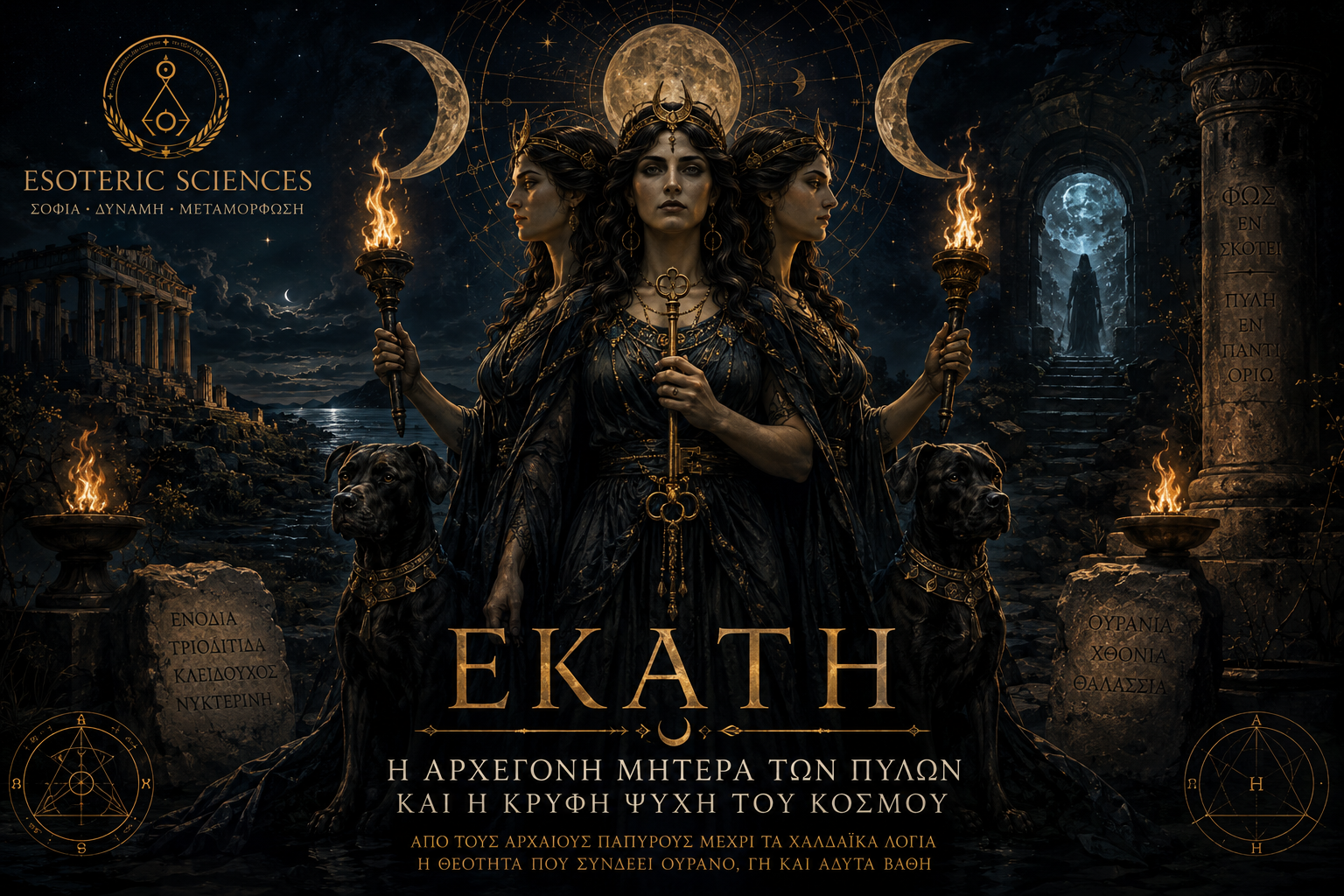
Hecate — The Primordial Mother of the Gates and the Hidden Soul of the World
From Hesiod, the Homeric and Orphic Hymns to the Greek Magical Papyri and the Chaldean Oracles: the deity who stands between worlds, holds the keys to the passages, and carries power from the unseen into the visible.
Hecate is not simply the goddess of magic, night or witches. That is only her best-known and most superficial image. Behind the torches, keys, dogs and crossroads stands a deity of far greater scope: a power that touches heaven, earth and sea, accompanies life from birth to death, and appears whenever one form must dissolve so that another may be born.
Hecate does not appear when everything is clear. She appears at the threshold.
In symbolic and initiatory interpretation, her presence is linked to moments when an old state has come to an end while the next has not yet taken a clear form. The crossroads, the gate and the key thus become symbols of transition, choice and change.
The Gate of Hecate
Across time, Hecate has been associated with crossroads, boundaries, entrances and passages. Her image as the Key-Bearer symbolically expresses authority over entry and exit, opening and closing.
Hecate and the Sacred Feminine
In more recent esoteric approaches, Hecate’s many forms are also used as a symbol of feminine autonomy, intuition, boundaries, shadow, creativity and inner sovereignty.
History gives us traces — not the whole mystery: there is no single, unchanging “doctrine of Hecate.” Her image changes from Archaic Greece to Hellenistic and Roman Egypt, the Magical Papyri, the Chaldean Oracles and Late Neoplatonism. [1]
The sources preserve names, hymns, titles and ritual traces. They do not always preserve the ways in which knowledge was transmitted orally, from priest to initiate and from threshold to threshold. This leaves significant room for historical research as well as later symbolic interpretation.
Before the Witch: Hesiod’s Great Hecate
The earliest extensive Greek presentation of Hecate is found in Hesiod’s Theogony. There she does not appear as a marginal or exclusively dark deity. She is the daughter of Asteria and Perses, belongs to the generation of the Titans, and holds honors on earth, at sea and in the starry heavens. [2]
After Zeus prevails, Hecate does not lose her former powers. Zeus honors her and allows her to retain what she already possessed under the previous divine order.
Hesiod presents her as aiding kings in judgment, warriors in battle, athletes in contests, horsemen, fishermen, shepherds and those who work for the increase of their herds.
Heaven, earth and sea can be read symbolically as an indication that her power is not confined to a single realm or function.
Kourotrophos: The Power that Nourishes What Is Born
At the end of Hesiod’s hymn, Hecate is presented as Kourotrophos, the one who nourishes and protects the young. This quality greatly broadens the image of a deity associated only with graves, ghosts and magic.
In symbolic interpretation, this aspect can be associated with the protection of every new state that has not yet stabilized: a new life, a new identity, a project or a new cycle.
“Hecate does not create in order to keep creation bound to her. She leads it to the gate, gives it light, and allows it to cross the road.”
Feminine Power as a Symbol of Inner Sovereignty
In contemporary esoteric and archetypal readings, Hecate has been associated with a form of femininity that is not confined to passivity or to one specific social role. She symbolizes discernment, autonomy, knowledge of boundaries and the ability to choose.
Hecate’s ancient triplicity is not historically identical to the later “Maiden–Mother–Crone” model. Her multiplicity, however, has been used in more recent psychological and esoteric interpretations as a symbolic mirror of different aspects of the feminine.
The Woman Who Holds the Key
A symbol of inner authority, choice and autonomy.
The Guardian of Boundaries
A symbolic distinction between care and self-abandonment, between union and the loss of self.
The Woman of the Night
Night and shadow are used as symbols of instinct, the hidden, and aspects of the personality that are not easily expressed.
The Mother of the Threshold
Hecate’s kourotrophic dimension can symbolically express the protection of what has just been born without the need to control it.
Hecate in the Myth of Demeter and Persephone
In the Homeric Hymn to Demeter, Hecate hears Persephone’s cry when she is carried away to the Underworld. Later she meets Demeter holding torches and accompanies her in the search for the truth. When Persephone returns, Hecate becomes her companion and attendant. [3]
Her position is unique. She is neither the mother who lost the child nor the god who carried her away. She is the one who heard the cry between the worlds.
Her torch can be read symbolically as the limited light that makes movement through an unknown space possible.
The Torch
Light in the night and symbolic guidance into the unknown.
The Key
Authority over entrance, exit and the boundary.
The Dog
Guardian of the boundary and a characteristic animal of her cultic image.
The Crossroads
A place of choice, transition and the meeting of different roads.
The Orphic Hymn: Heavenly, Chthonic and Marine
The first of the surviving Orphic Hymns is addressed to Hecate. It calls her Enodia and Trioditis, while at the same time presenting her as heavenly, chthonic and marine. [4]
This multiplicity is one of the deity’s most important characteristics and helps explain why Hecate became associated with different realms and functions.
The modern idea of “Maiden–Mother–Crone” is not the primary way in which ancient sources explain Hecate’s triple form. Ancient triplicity is more closely related to roads, directions and different realms of the world.
Hecate in the Greek Magical Papyri
The Greek Magical Papyri are a collection of ritual texts from Greco-Roman Egypt. They include invocations, hymns, oracles, protective practices and other ritual prescriptions. [5]
Within these texts Hecate is an important point of syncretism and is functionally associated with different divine figures:
The syncretic logic of the Papyri does not function like a modern mythology handbook. Names, attributes and divine functions can be combined within the same ritual environment.
The Magical Papyri do not prove that all these deities were historically “one and the same.” They do show, however, that ritual practitioners of Late Antiquity could combine different divine figures with related functions.
Hecate and Ereshkigal: The Queen Behind the Name
Ereshkigal is the great lady of the Mesopotamian Underworld. Her name appears in the Greek Magical Papyri and in certain texts is associated with Hecate. [6]
Historically, this connection does not prove that Greek Hecate originated from Ereshkigal. It is an example of the syncretism of Greco-Roman Egypt.
On a symbolic level, the two figures can be compared through their relationship with depth, the Underworld, boundaries and transition. This is an interpretive comparison, not a historical identification.
Hecate and Tiamat: Historical Identification or Archetypal Comparison?
Tiamat belongs to Babylonian cosmogony and represents the primordial salt waters before the establishment of the ordered world. [7]
No known ancient Greek text or Magical Papyrus survives that states that “Hecate is Tiamat.” The connection between the two is a later comparative or initiatory interpretation, not a documented ancient identification.
In an archetypal reading, Tiamat may symbolize primordial unformed depth, while Hecate symbolizes the boundary and the transition from one state to another.
| Figure | Historical Function | Symbolic Reading |
|---|---|---|
| Tiamat | Primordial cosmic waters in Babylonian cosmogony. | The unformed and primordial potential. |
| Ereshkigal | Lady of the Mesopotamian Underworld. | Depth and descent. |
| Hecate | Greek deity of boundaries, roads and transitions. | The threshold, the key and the crossing. |
The Chaldean Oracles: Hecate as Cosmic Power
In the Chaldean Oracles and in their later theurgical interpretation, Hecate acquires a particularly elevated metaphysical position and is presented as a mediating power between different levels of cosmic reality. [8]
In the later Platonic and theurgical tradition she is associated with Power, cosmic mediation and the psychic principle. Precise interpretations differ according to author and philosophical school.
The Intelligible Level
The higher metaphysical principle within theurgical systems.
Hecate as Power
The mediating principle between different levels of reality.
The Soul
The living movement that connects the intelligible with nature.
The Manifested World
The level of multiplicity and individual forms.
Hecate’s association with cosmic and psychic principles is an important chapter in her later theurgical and Neoplatonic reception. Initiatory interpretations that present her as a primordial matrix or absolute principle should be distinguished from the earlier Greek mythological sources.
The “Unborn Hecate” as an Initiatory Interpretation
Greek mythological genealogies present Hecate as the daughter of Asteria and Perses. Therefore, the idea of an “Unborn Hecate” preceding every divine principle is not a literal position of the Hesiodic genealogy.
In later esoteric and initiatory readings, however, the figure of Hecate may be used as a symbol of potential before form, the threshold before creation, and the transition from the formless to the manifested.
The distinction is important: what an ancient text explicitly states is one thing, while a philosophical, archetypal or initiatory interpretation developed upon the ancient material is another.
Why Hecate Is Associated with So Many Different Realms
The long history of Hecate’s worship and reception created an exceptionally complex body of symbols, attributes and theological functions.
Moon and Night
Connections that became especially strong in later traditions.
Death and Souls
Her chthonic dimension links her with the world of the dead and with passages.
Magic and Theurgy
A particularly important presence in the magical and theurgical literature of Late Antiquity.
Herbs and Pharmaka
Later tradition also links her with plants, medicines and poisons.
Boundaries and Consequences
The crossroads is a powerful symbol of choice and diverging directions.
Sea
Already in Hesiod, her authority is not confined to the land but extends to the sea.
Birth and Nurture
Her quality as Kourotrophos reveals an important protective dimension.
Gates and Protection
Entrances, boundaries and thresholds are enduring elements of her symbolic presence.
One Deity with Many Names, or One Archetype with Many Forms?
Ancient polytheistic thought did not always require a single answer. Two deities could be distinct and yet meet within a shared function. A foreign name could be added to an invocation without erasing the separate tradition from which it came.
Archetypal and initiatory interpretation proceeds differently: it examines recurring symbols such as depth, the womb, loss, return, dissolution, rebirth and transition.
This does not mean that Hecate, Ereshkigal, Tiamat, Rhea, Selene and Persephone were historically different names for a single deity. These comparisons belong primarily to the fields of comparative, symbolic and esoteric interpretation.
Hecate as the Timeless Symbol of the Gate
From Archaic poetry to the theurgy of Late Antiquity, Hecate transforms without losing one of her most characteristic functions: her relationship with the boundary, the passage and the threshold.
This is why her image remains so powerful. The torch, the key, the crossroads, the night and the gate form a symbolic vocabulary that has been used for centuries to speak of what lies between two states.
Note: The initiatory, archetypal and esoteric interpretations in this article are presented as elements of religious, philosophical and esoteric traditions. They are not a substitute for medical, psychological or psychiatric care.
Key Ancient Texts and Traditions Used in This Article
- The historical development of Hecate’s worship and theological image from the Archaic period to Late Antiquity.
- Hesiod, Theogony — Hecate’s honors on earth, at sea and in heaven.
- Homeric Hymn to Demeter — Hecate as witness to the abduction and companion of Persephone.
- Orphic Hymn to Hecate — Enodia, Trioditis, heavenly, chthonic and marine.
- Greek Magical Papyri — invocations, syncretic forms and ritual functions.
- The presence of Ereshkigal in ritual texts from Greco-Roman Egypt.
- Epic of Creation — the cosmogonic figure of Tiamat.
- Chaldean Oracles and later theurgical tradition — Hecate as cosmic Power and mediating principle.
Αυτή η ανάρτηση είναι επίσης διαθέσιμη σε:
 Français
  Español
  Ελληνικά
