
La Voie du Vide — Center for Esoteric Sciences

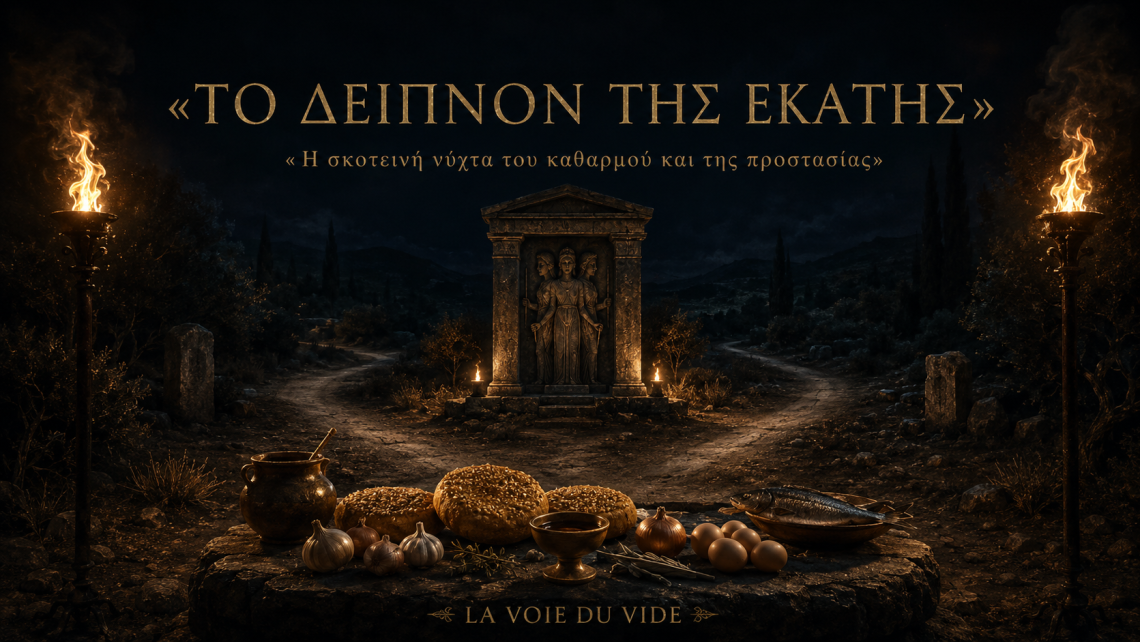
Hecate’s Deipnon — The Dark Night of Purification and Protection

Library of Ancient Greek Tradition

Hecate’s DeipnonThe Dark Night of Purification and Protection

Before the first new crescent appeared, the old month had to come to a close. The household was cleansed, burdens were removed, and a supper was left for Hecate, where roads meet and direction changes.

The final night

It was not a feast of abundance. It was a ritual of closure.

The word deipnon meant the main evening meal. Hecate’s Deipnon, however, was not an ordinary family supper. It was a monthly offering to the goddess of boundaries, roads, doorways and transitions, performed at the end of the Attic lunar month.

The rite stood exactly between two times: the old month had almost ended, but the new one had not yet appeared in the sky. This invisible, dark phase was a liminal threshold. Whatever had accumulated within the household—ritual impurity, tension, transgressions and remnants of purification—was not meant to pass into the new beginning.

The Deipnon was therefore connected with three functions: honouring Hecate, purifying the household, and making a safe transition toward the Noumenia.

The Deipnon belongs to the moment when the Moon remains invisible. The Noumenia begins with the first visible slender crescent: first the old month closes, and then the new one is born.
The lunar rhythm

When exactly did it take place?

There was no fixed date in the modern calendar. The Deipnon returned every lunar month.

End of the old monthHene kai NeaThe “old and new” day, the final day of the Attic month. The Moon was in its dark phase, and the Deipnon took place.
First visible crescentNoumeniaWith the appearance of the first slender crescent, the new month began. It was a day of renewal and auspicious beginnings.
Second dayAgathos DaimonHonour to the Agathos Daimon followed—the protective and beneficent power of the household.
A practical calculation today: Choose the evening of the astronomical New Moon or the last evening before the first slender crescent becomes visible. Visibility depends on the season, location and horizon; the crescent usually appears about one to two days after the astronomical conjunction.
The sacred boundary

Why Hecate, and why at the three-way crossroads?

01 · HECATE ENODIA

Lady of the Roads

Hecate was associated with entrances, boundaries and crossroads—places where one road ends and another begins. There, the known meets the unknown, and a direction must be chosen.

Roads · Transition · Direction
02 · HECATE PROPYLAIA

Guardian of the Threshold

Images and small shrines of Hecate were placed near doors and entrances. The threshold of the home was both a practical and sacred boundary: it separated the protected household from the public road.

Household · Boundaries · Protection
03 · PURIFICATION

What had to leave

Remnants of purification and ritual refuse were carried outside the household. Not everything was “food for the goddess”; some of it was precisely what the household was casting away.

Purification · Removal · Closure
04 · THE UNSEEN COMPANIONS

The night of restless souls

In later literature, Hecate appears accompanied by souls and chthonic presences. The supper also had an apotropaic function: it acknowledged the forces beyond the household boundary without inviting them inside.

Averting · Night · Sacred Boundary
The ancient table

What was offered to Hecate?

The Deipnon included simple foods with sacred and purificatory character, together with what had to be removed from the household before the beginning of the new lunar month.

◯EggsThey are frequently mentioned in ancient and later discussions of the Hekates deipna.
✧PlakountesBreads or cakes, sometimes with honey, offered as ordinary food offerings.
⌁FishEspecially kinds that literary sources associate with the suppers and the goddess.
❧Garlic and onionsFoods with strong purificatory and apotropaic symbolism in ancient thought.
♨IncenseSmoke and fragrance could accompany the honour paid to the deity.
☽KatharmataRemnants from the purification of the home that had to be removed from the household.
◇LibationWater, wine or another liquid could be poured as an offering of honour.
✦The lightThe modern use of a candle fits the symbolism of Hecate’s torches, but by itself it is not a full reconstruction of the ancient Deipnon.
The sacred procedure

How was Hecate’s Deipnon performed?

The ritual followed the transition from the old month to the new: first the household was purified, then the offering was prepared, and finally it was given to Hecate at the threshold or the three-way crossroads.

Purification of the householdBefore the offering, the home was cleaned and the remnants of purification were gathered. This was not merely tidying; it symbolised that the old month was closing and that its burden would not pass into the next.
Preparation of the sacred supperThe offering foods were prepared—breads or plakountes, eggs, honey, fish, garlic, onions and a libation, depending on local custom and the household. Once dedicated, they belonged to the goddess.
Procession to the boundaryAfter sunset, the supper was carried to a three-way crossroads, a Hekataion, or near the gate of the home. The place mattered: there the protected domain of the household ended and the unknown road of Enodia began.
Dedication to HecateThe offering was placed with reverence and accompanied by an invocation, prayer or libation. Symbolically, it also carried away what needed to leave: impurity, disturbance and the burdens of the cycle that was ending.
Departure and closureAfter the offering was deposited, people returned to the household and left the supper at the sacred boundary. The dedication was now complete: what had been given to Hecate did not return to the space of the home.
Waiting for the NoumeniaThe dark night belonged to closure. With the first visible slender crescent, the Noumenia began, and with it the new month—now clear for wishes, plans and new beginnings.
Religion and society

The supper that the poor could take

Aristophanes, in Plutus, refers to the monthly suppers left for Hecate by the wealthy and taken by the poor. His reference shows how recognisable the custom was in everyday Athenian life.

Thus the offering did not remain only on the invisible level of worship. It could also become real food for someone who needed it. That thread can still be preserved today through an act of generosity in Hecate’s name.

The Deipnon in the modern world

How can we observe it today?

The essence of the ancient act remains alive: we cleanse the space, consciously close the old cycle, honour Hecate, and ask for protection, help and clear direction before a new beginning.

1. Choose the right nightThe evening of the astronomical New Moon or the last evening before the first slender crescent appears.
2. Cleanse with purposePut the space in order, discard what has spoiled or is no longer used, settle a small outstanding matter, and write down what you do not want to carry into the new month.
3. Light Hecate’s flameAt your personal shrine or near the entrance, light a candle. The flame recalls the goddess’s torches: those that reveal the road through the dark night.
4. Prepare the offeringPlace a little bread or cake, an egg, honey, and clean water or wine on a clean plate. You may also offer food to someone who needs it, dedicating the act to Hecate.
5. Make the dedicationStand before the offering and speak clearly. Ask Hecate to purify the household, guard its boundaries, remove obstacles and illuminate the road opening before you.
6. Close the rite and move into the NoumeniaThank Hecate. In the next phase, when the first crescent appears, write down a new intention and take one concrete action that serves it.
Words of dedication

“Hecate Enodia and Propylaia, Lady of the Roads and Guardian of Boundaries, receive this supper and my honour. Purify my household of what has completed its cycle, guard the entrance and illuminate the road opening before me. With gratitude I bid farewell to the old and prepare to receive the new.”

For protection

  • Ask that the boundaries of the household be strengthened and that every heavy influence be removed.
  • Place your intention at the entrance, where the inner and outer worlds symbolically meet.
  • Close the rite with thanks to Hecate Propylaia, Guardian of the Threshold.

For help and opening the way

  • Name the matter for which you need guidance.
  • Ask that the right road be revealed and that whatever obstructs your path be removed.
  • When the first crescent of the Noumenia appears, take the first real step toward the new direction.
The power of the Deipnon today

What does it truly mean?

ProtectionHecate Propylaia guards the threshold. The Deipnon becomes an act of strengthening the household’s boundaries and removing what should not pass into the new cycle.
PurificationRemoving objects, habits and unfinished matters that keep the household and the individual bound to the previous cycle.
Help and directionAs Enodia and Trioditis, Hecate is associated with roads and points of choice. Honouring the goddess asks for light, a sign and clear direction.
The darkness before the first crescent

First we cleanse. Then we begin.

This is the deeper message of Hecate’s Deipnon: no new beginning is truly new if we continue to carry into it what should already have ended.

See all the Ancient Greek Gates
LA VOIE DU VIDE · LIBRARY
Historical sources: The research for this article is based on ancient testimonies and studies of ancient Greek religion: Aristophanes, Plutus 594–597; Athenaeus, Deipnosophistae; Plutarch, Moralia 709A; Robert Parker, Miasma and Polytheism and Society at Athens; Sarah Iles Johnston, Restless Dead; H. W. Parke, Festivals of the Athenians.

Αυτή η ανάρτηση είναι επίσης διαθέσιμη σε: Français Español Ελληνικά

Entry Gates
Choose your sign or move directly to the right path.
♈︎Aries♉︎Taurus♊︎Gemini♋︎Cancer♌︎Leo♍︎Virgo♎︎Libra♏︎Scorpio♐︎Sagittarius♑︎Capricorn♒︎Aquarius♓︎Pisces
✦Intensive Mentorship✧Spiritual Life Coaching𓂀Via Énôdia · Occult School✉Contact